A. Castro, G. Gutiérrez-Alonso, C. Fernández, C. Rodríguez, D. Gómez-Frutos, M. Francisco Pereira, B. Solís-Alulima, J. de la Rosa. Journal of Iberian Geology, 2026
https://link.springer.com/article/10.1007/s41513-026-00338-9
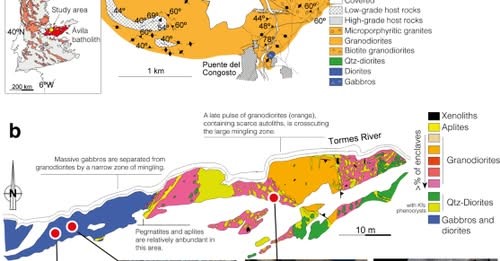
The Puente del Congosto intrusive complex, exposed along the northern margin of the Ávila batholith (Central Iberian Zone, Spain), documents the post-collisional association between sanukitoid (vaugnerite-type) mafic–intermediate rocks and granodiorites. Field relationships show high-Mg gabbros forming angular bodies enclosed by diorites and quartz-diorites, which interact with granodiorites through magma mingling and enclave formation. Despite sharp contacts, whole-rock geochemistry defines a near-continuous compositional spectrum from high-Mg gabbros (MgO >10 wt%) to granodiorites. Gabbros are enriched in K2O, Cr, and Ni and display crust-like Sr–Nd isotopic signatures, indicating derivation from mantle magmas modified by assimilation of pelitic metasediments. Orthopyroxene compositions and textural evidence suggest formation in reactive systems involving thermal erosion of crust and extraction of granodioritic melts, leaving Opx-rich residual gabbros. Zircon U–Pb SHRIMP dating yields indistinguishable crystallization ages of ca. 305 Ma for both gabbros and granodiorites, demonstrating near-coeval mantle and felsic magmatism during late Variscan extension. Isotopic data argue against simple fractional crystallization and instead support hybrid mantle–crust sources. The Puente del Congosto complex records high-temperature mantle input, crustal assimilation, and melt segregation processes that contributed to the generation of post-collisional granodiorite batholiths in the Iberian Massif.