J. Felicidade, F. G. Blandón-Cumbreras, J. F. Arteaga, P. Remón, A. Fernandes, G. Salluce, G. Gasser, F. Nájera, M. F. Santos, U. Pischel, P. M. P. Gois. ChemistryEurope, 2026
https://doi.org/10.1002/ceur.70362
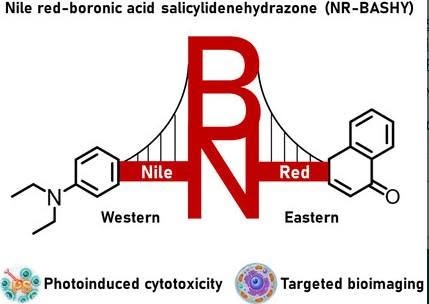
Small dyes are indispensable tools for probing biological processes. Among them, Nile Red (NR) is widely used for imaging lipid-rich environments. However, the structural diversification of its phenoxazine core remains limited. Herein, we exploit B─N/C─C isosterism to connect the western and eastern fragments of NR through a B─N linkage, enabling the design of NR-inspired boronic acid-derived salicylidenehydrazone (NR-BASHY) dyes with enhanced structural and functional versatility. This strategy allows the modular one-pot synthesis of NR-BASHY dyes, which exhibit promising photophysical properties. These include intense absorption (ε up to 50,800 M–1cm–1) and high brightness (ε × Φf up to 17,000 M–1 cm–1) and a pronounced solvatofluorochromism with emission spanning the red to near-infrared spectral region. In strong contrast to NR, NR-BASHY can act as photosensitizers, featuring efficient singlet-oxygen generation (ΦΔ up to 0.8) and photoinduced cytotoxicity against the U87 glioblastoma cell line in the submicromolar range (IC50 ca. 0.5 μM), while maintaining low dark toxicity (>100 μM). Moreover, the modular architecture of NR-BASHY dyes enables click-reaction mediated bioconjugation with the GV1001 peptide, highlighting the potential of this platform for targeted bioimaging applications.