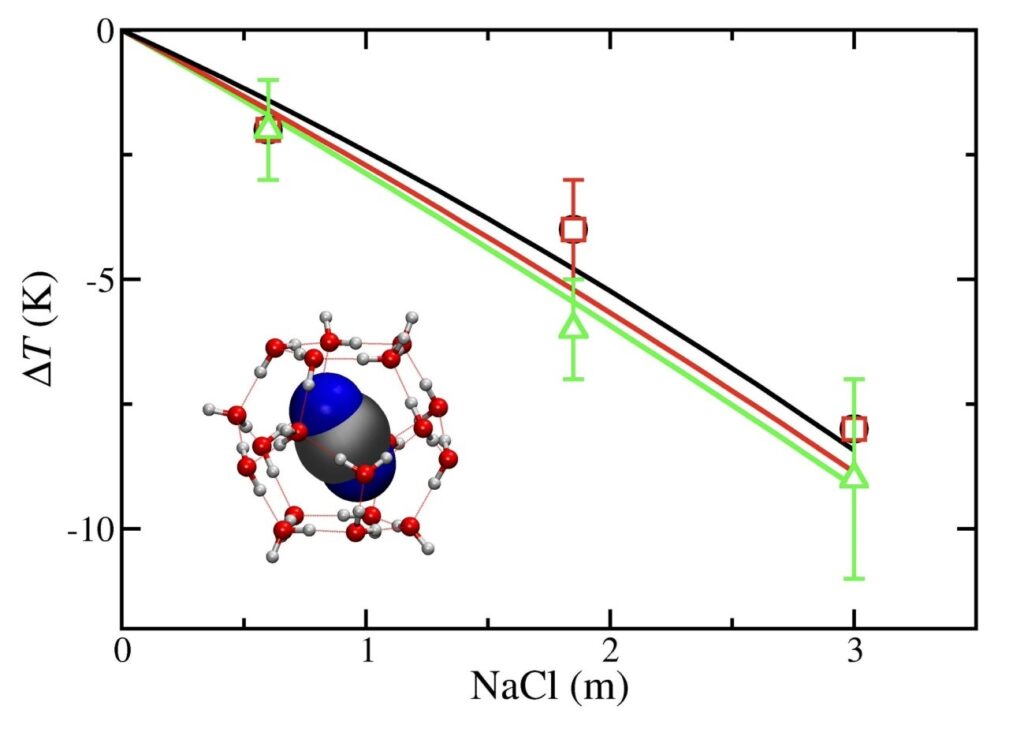
A. Borrero, A. Díaz-Acosta, S. Blázquez, I. M. Zerón, J. Algaba, M. M. Conde, F. J. Blas, Energy & Fuels, 2025
https://pubs.acs.org/…/10.1021/acs.energyfuels.5c00174
In this work, the cryoscopic decrease effect, as a function of the NaCl concentration, on the carbon dioxide (CO2) hydrate dissociation line conditions was determined through molecular dynamic simulations. In particular, we have determined the three-phase (solid hydrate−aqueous phase−liquid CO2) coexistence temperature at 100, 400, and 1000 bar at several initial NaCl concentrations in the aqueous phase, from 0.0 to 3.0 m, using the direct-coexistence technique. We used the well-known TIP4P/2005 and TraPPe forcé fields for water and CO2 molecules, respectively. Also, the water−salt interactions were described using the Madrid-2019 force field, which has been specifically developed for various salts in combination with the TIP4P/2005 water model. According to the results obtained in this work, the dissociation temperature ofthe CO2 hydrate decreases when the NaCl concentration in the initial aqueous phase increases. The results obtained are in excellent agreement with the experimental data reported in the literature. We have also observed how the dynamics of melting and growth of the CO2 hydrate becomes slower when the NaCl concentration is increased. As a consequence, longer simulation times (on the order of dozens of microseconds) are necessary when the NaCl concentration increases. Finally, we have also analyzed finite-size effects on the three-phase coexistence temperature of these systems by performing simulations at 400 bar with two different system sizes at two different NaCl concentrations (0.0 and 3.0 m). Non-negligible deviations have been found between the results obtained from the two system sizes.