C. Benítez-Martín, J. Rouillon, E. Fron, F. de Jong, M. Grøtli, J. Hofkens, U. Pischel, J. Andréasson, Nature Communications, 2025
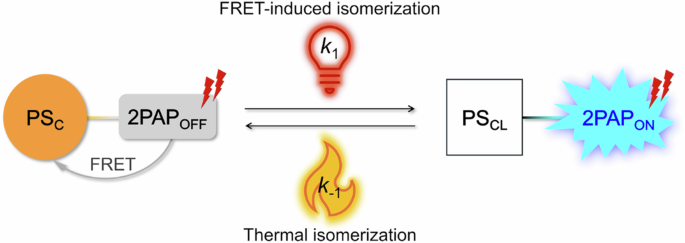
Combining nonlinear optical processes and photoswitching transcends the limitations of conventional and even standalone super-resolution imaging. While photoswitching enables resolution improvement, it is typically constrained by limited imaging depth, potential phototoxicity and the low number of inherently fluorescent photoswitches. Nonlinear excitation, such as two-photon absorption, addresses some of these challenges. Here, we present a molecular design strategy that unites the molecular control of T-type negative photoswitches (PS) and two-photon absorption. In these designs, two-photon absorbing push-pull fluorophores that function as FRET-donors are linked to T-type negative PS FRET-acceptors, e.g., donor-acceptor Stenhouse adducts (DASA) or 1,1′-binaphthyl-bridged imidazole dimers. FRET-sensitized isomerization of PS is delicately balanced by reverse thermal isomerization and results in nonlinearly potentiated fluorescence with a quartic fluorescence response upon two-photon excitation, implying enhanced spatial resolution potential. The use of T-type PS is instrumental to this approach, as it ensures temporally stable photonic responses and recyclability without incurring irreversible saturation effects.